
Introduction
If you’ve spent weeks writing the perfect blog post, optimized every heading, added the right keywords, and still your website sits on page 3 of Google you’re not alone.
This is one of the most frustrating situations in SEO. And the truth most beginners never hear is this:
“If your website has great content but still no traffic, the problem is almost always Off-Page SEO.”
On-Page SEO tells Google what your content is about. But Off-Page SEO tells Google whether your website deserves to rank. In 2026, with millions of AI-generated articles flooding the internet every day, Google has become dramatically more strict about which websites it trusts. If your site doesn’t have external authority signals, even a perfectly written article will struggle to rank.
In this complete beginner’s guide you will learn:
- What Off-Page SEO actually is
- Why it matters more than ever in 2026
- The best strategies to build authority step-by-step
- The exact mistakes that can destroy your rankings
- A practical weekly checklist to stay consistent
Let’s get started.
What is Off-Page SEO?
Off-Page SEO refers to every action you take outside your own website to improve your position in search engine results pages (SERPs). While On-Page SEO is about optimizing your content, structure and code, Off-Page SEO is about building your website’s reputation, authority and trust in the eyes of Google.
Think of it this way: On-Page SEO is building a great restaurant. Off-Page SEO is getting Michelin star reviews, press coverage and word-of-mouth recommendations. Google is the food critic and it listens to what others say about you.
On-Page SEO vs Off-Page SEO
| Feature | On-Page SEO | Off-Page SEO |
|---|---|---|
| Location | Inside your website | Outside your website |
| Main focus | Content & keywords | Authority & trust |
| Examples | Title tags, meta description, headings | Backlinks, brand mentions, digital PR |
| Who controls it | You | Other websites + audience |
| Goal | Relevance | Credibility |
| Tools | Yoast SEO, Rank Math | Ahrefs, Semrush, Google Alerts |
Off-Page SEO in 2026 includes:
- Backlinks — Links from other websites pointing to yours
- Brand mentions — When your brand is named online (with or without a link)
- E-E-A-T signals — Proof that real, credible people are behind your content
- Digital PR — News coverage, podcast appearances, journalist mentions
- Social signals — Content shares and brand engagement across platforms
- Local citations — Business listings and NAP consistency
- Entity SEO — Google understanding who you are as a brand or author
Why Off-Page SEO is Important in 2026
The SEO landscape changed dramatically in the last two years. Here is why Off-Page SEO now matters more than ever before.
1. AI Content Saturation
In 2026, anyone can publish 100 articles in a day using AI tools. Google’s search index is flooded with AI-generated content that is technically optimized but carries zero real-world credibility. To separate genuine experts from automated content farms, Google relies heavily on Off-Page signals external proof that real people trust your site.
2. Google’s Spam Brain Is Smarter
Google’s SpamBrain algorithm now detects not just the presence of a link, but the intent behind it. Spam links, link farms, and unnatural anchor text patterns are identified and devalued automatically. Only authentic, editorially earned links pass trust.
3. E-E-A-T Is Now a Ranking Foundation
Google’s Quality Rater Guidelines explicitly state that Experience, Expertise, Authoritativeness and Trustworthiness (E-E-A-T) are central to how content is evaluated. Off-Page signals are the primary way Google measures three of those four pillars authority, expertise, and trust.
4. Brand Mentions Are Now Direct Ranking Signals
A 2025 industry study by SearchAtlas found that brand mentions and entity signals now comprise 55% of off-page influence, while backlinks account for approximately 45% down from 80% a decade ago. Unlinked brand mentions can influence rankings on their own in 2026.
Off-Page SEO Stats Worth Knowing
- 66.31% of all web pages have zero backlinks and almost none of them rank in Google’s top 10 (Ahrefs)
- 80.9% of SEO professionals believe unlinked brand mentions influence organic rankings (BuzzStream, 2025)
- Pages with backlinks rank 3.8x higher than those without (Xpand Digital, 2026)
- Long-form content of 3,000+ words earns 77.2% more backlinks than short articles (Backlinko)
- Every 10-point Domain Authority increase corresponds to roughly 15% better ranking ability for competitive keywords (Ranktracker, 2025)
How Google Evaluates Off-Page SEO
Before you start building off-page signals, you need to understand how Google actually measures them.
Backlinks: Quality vs Quantity
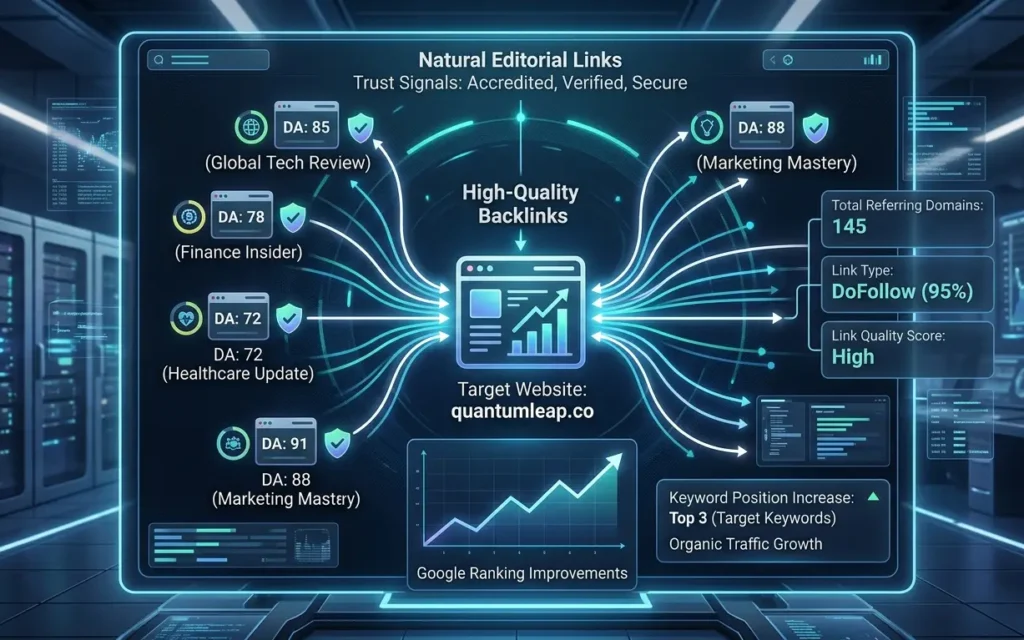
Not all backlinks are created equal. In 2026, one editorial backlink from a high authority, relevant website is worth more than 500 spammy links from irrelevant directories.
Google evaluates backlinks based on:
- Domain Authority of the linking site
- Topical relevance — does the linking site relate to your niche?
- Anchor text — is it natural or over-optimized?
- Link placement — editorial links in content outrank footer or sidebar links
- Follow vs. NoFollow — both matter, but dofollow links pass more ranking power
Brand Mentions (Linked and Unlinked)
Google’s NLP (Natural Language Processing) technology can now understand context well enough to recognize your brand name even when there is no link attached. When your brand is consistently mentioned across credible publications, forums, and social platforms, Google builds a picture of your authority.
Set up Google Alerts for your brand name today. Every unlinked mention is a potential link you can reach out and claim.
E-E-A-T Signals
Google uses E-E-A-T to decide if your content should be trusted. Here’s how each pillar connects to Off-Page SEO:
| E-E-A-T Pillar | What It Means | Off-Page Signal |
|---|---|---|
| Experience | Real, first-hand knowledge | Author bio, case studies, mentions |
| Expertise | Deep subject knowledge | Guest posts, citations from experts |
| Authoritativeness | Recognized by others in your field | Backlinks, press coverage, interviews |
| Trustworthiness | Safe and credible | Reviews, testimonials, secure site |
User Engagement Signals
Google watches how users interact with your content. A high Click-Through Rate (CTR) from search results, long dwell time, and returning visitors all signal that your content is genuinely valuable and rankings follow.
Topical Authority
This is one of the most important Off-Page concepts in 2026. Google rewards websites that demonstrate deep expertise across a specific topic cluster. When multiple authoritative sites link to your articles about SEO, Google begins to treat your entire website as a trusted authority on SEO not just one article.
This is why building an Off-Page strategy around a single niche is always more powerful than scattered, unrelated content.
Best Off-Page SEO Techniques for Beginners in 2026
1. High-Quality Link Building (White Hat Backlinks)
Link building is still the backbone of Off-Page SEO. But in 2026, the approach has completely changed. Forget buying links, using link farms, or spamming blog comments. The only backlinks that work today are ones that Google would be proud to recommend.
The types of backlinks that actually help:
- Editorial links — A journalist or blogger links to your content because it added value to their article
- Contextual backlinks — Links placed naturally within the body content of a relevant article
- Resource page links — Websites that list helpful resources in your niche and include your article
- Skyscraper backlinks — Find a popular article, write something 10x better, then ask sites linking to the original to link to yours instead
What to avoid completely:
- Private Blog Networks (PBNs)
- Paid backlinks from link sellers
- Automated link building tools
- Footer links and sidebar spam
- Exact-match anchor text stuffing
2. Guest Posting: The Right Way
Guest posting means writing a high-quality article for another website in your niche. When done correctly, it earns you a contextual backlink, builds your author credibility, and exposes your brand to a new audience.
How to find guest posting opportunities: Search Google for:
your niche + "write for us"your niche + "guest post"your niche + "submit article"
Outreach Email Template:
Subject: Guest Post Idea for [Website Name]
Hi [Name],
I‘ve been reading [Website] for a while and particularly loved your article on [specific post]. I’m an SEO writer who specializes in [your niche].
I’d love to contribute a guest post on one of these topics: 1. [Topic Idea 1] 2. [Topic Idea 2]
My writing has been featured on [mention any past publications if applicable], and I’m confident the article will bring real value to your audience.
Would you be open to this? I’m happy to share a full outline first.
Best, [Your Name]
Rules for quality guest posts:
- Only post on websites relevant to your niche
- Write genuinely helpful, original content not a thin promotional piece
- Include only one natural backlink to your own site
- Target sites with real organic traffic, not just high DA scores
3. Digital PR: Earning Authority Naturally
Digital PR is one of the highest-impact Off-Page strategies in 2026. It means getting your brand or expertise mentioned in real news outlets, podcasts, industry blogs, and online publications the kind of mentions that build genuine authority.
Beginner-friendly Digital PR tactics:
HARO Alternatives (Help a Reporter Out equivalents in 2026):
- Qwoted — Connect with journalists looking for expert sources
- Featured.com — Submit your expert insights to articles
- SourceBottle — UK/Australia-focused media outreach platform
- JournoRequests on X (Twitter) — Journalists post real-time source requests
How to use these:
- Sign up and create a credible author profile
- Monitor daily queries in your niche (SEO, digital marketing)
- Reply with concise, genuinely expert answers
- When your quote is used, you earn a backlink from a credible publication
Even one placement in a respected industry blog can produce months of ranking authority.
4. Social Media Signals
To be clear: social media likes and shares are not direct Google ranking factors. Google has confirmed this multiple times. However, the indirect effects are powerful.
When your content goes viral on LinkedIn, gets shared on Reddit, or discussed in a Facebook group, it increases the probability that a blogger or journalist will find it and link to it. Social distribution is a backlink trigger, not a backlink itself.
Best platforms for SEO-related social signals in 2026:
- LinkedIn — Best for B2B content, thought leadership, and reaching marketing professionals
- X (Twitter) — Follow #SEO and #DigitalMarketing hashtags; journalists actively look for sources here
- Reddit — Subreddits like r/SEO, r/blogging, and r/juststart have large, engaged audiences. Share genuinely helpful content, not promotions.
- YouTube — Video content that ranks on YouTube also shows up in Google search results, giving you a second visibility channel
- TikTok — Short-form SEO tips are growing rapidly; great for brand awareness among younger marketers
Content that performs well on social for SEO:
- Original data or case studies
- Infographics with surprising statistics
- “Before and after” SEO results
- Contrarian takes on SEO myths
- Quick actionable tips in carousel format
5. Forum and Community Engagement
Participating authentically in online communities builds brand awareness, earns trust, and occasionally produces backlinks all without spending a cent.
Best communities for SEO beginners:
- Reddit (r/SEO, r/blogging, r/affiliatemarketing) — Answer questions with genuine expertise
- Quora — Detailed answers to SEO questions drive referral traffic and brand recognition
- Facebook Groups — Niche marketing groups are active and link-friendly
- Indie Hackers — Great for content creators and bloggers sharing their growth stories
The golden rule: Add genuine value first. Promotional posts that exist only to drop your link get flagged as spam and damage your brand reputation instead of building it.
6. Local SEO Citations
If ClickBloomer serves local businesses or targets a specific geographic market, local citations are essential Off-Page signals.
What is a local citation? A citation is any online mention of your business’s Name, Address, and Phone number (NAP). Google uses consistent NAP data across the web as a trust signal for local search rankings.
Essential citation sources:
- Google Business Profile (most important)
- Bing Places
- Apple Maps
- Yelp
- Facebook Business Page
- Industry-specific directories
Critical rule: Your business name, address, and phone number must be identical across every platform. Even small differences (“St.” vs “Street”) confuse Google’s entity matching system and reduce your local ranking authority.
7. Influencer and Brand Collaborations
Collaborating with established voices in your niche accelerates authority building far faster than building alone.
Practical collaboration ideas for beginners:
- Podcast appearances — Being interviewed on an SEO or marketing podcast earns a high-quality backlink from the show notes plus exposure to a targeted audience
- Expert roundup articles — Contribute a quote to a “Top 10 SEO Tips” roundup post and earn a contextual mention
- Co-authored content — Write an article together with a more established blogger and share audiences
- LinkedIn collaborations — Tag each other in educational posts to expand reach organically
- Webinar partnerships — Host a free training with someone in a complementary niche
8. Content Marketing for Natural Backlinks
Certain types of content attract backlinks naturally without any outreach at all. This is the highest-leverage Off-Page strategy for beginners because it scales over time.
Content formats that earn natural backlinks in 2026:
| Content Type | Why It Earns Links | Effort Level |
|---|---|---|
| Original research / statistics | Journalists cite data sources | High |
| Free tools / calculators | Users share useful resources | Very High |
| Ultimate beginner guides | Educators link to reference resources | Medium |
| Case studies with real results | Practitioners link to proof | Medium |
| Infographics | Visual content gets embedded with attribution | Medium |
| “State of [Industry]” reports | Media picks up annual data reports | High |
Example: If ClickBloomer published a “State of SEO in 2026” report with real survey data from 500 businesses, it would naturally earn dozens of backlinks from news sites, blogs, and social shares without sending a single outreach email.
Off-Page SEO Checklist for Beginners
Weekly Tasks
- Monitor brand mentions using Google Alerts
- Check for unlinked mentions and send one link reclamation email
- Engage authentically in 2 SEO-related Reddit threads or LinkedIn posts
- Share one new piece of content across LinkedIn, X, and relevant Facebook groups
- Respond to 1–2 HARO/Qwoted journalist queries in your niche
Monthly Tasks
- Publish or pitch one guest post to a relevant website
- Run a backlink audit using Ahrefs Webmaster Tools (free)
- Check for and disavow any toxic links via Google Search Console
- Identify 5 resource pages in your niche and reach out for inclusion
- Review your competitor backlink profile for new link opportunities
- Update your Google Business Profile (if applicable)
Quarterly Tasks
- Publish one original research piece, stat roundup, or industry report
- Analyze your top 3 competitors’ off-page strategy using Semrush or Ahrefs
- Audit NAP consistency across all business directories
- Review and refresh your author bio and About page
- Assess topical authority growth using Google Search Console impressions
Common Off-Page SEO Mistakes to Avoid
Beginners often damage their rankings before they even get started. Here are the most dangerous mistakes in 2026:
1. Buying backlinks Google’s Spam Brain detects paid link patterns. A manual penalty can remove your site from search results entirely. The risk far outweighs any short-term ranking gain.
2. Using Private Blog Networks (PBNs) PBNs are networks of fake websites created solely to sell backlinks. Google has become extremely effective at identifying and devaluing them.
3. Exact-match anchor text over-optimization If 80% of your backlinks say “best SEO agency Malaysia,” Google sees it as manipulation. Natural link profiles have diverse, varied anchor text.
4. Low-quality guest posting at scale Posting thin, generic articles on spammy “guest post” sites does nothing for your rankings and can trigger algorithmic penalties.
5. Ignoring toxic backlinks Negative SEO attacks are real. Competitors can sometimes point spam links at your site. Monitor your backlink profile monthly and disavow links from gambling, adult, or obvious spam domains.
6. Publishing AI spam content to “earn” links AI-generated content without real expertise signals fails Google’s E-E-A-T criteria and earns zero organic links. Quality must come before quantity.
7. Focusing only on backlinks and ignoring brand signals In 2026, brand mentions, social presence, and entity authority are equal partners to backlinks in Google’s evaluation system.
Best Off-Page SEO Tools in 2026
Free Tools
| Tool | What It Does |
|---|---|
| Google Search Console | Monitor backlinks, impressions, and manual actions |
| Google Alerts | Track brand mentions across the web |
| Google Trends | Identify trending topics in your niche |
| Ahrefs Webmaster Tools | Free site audit, backlink monitoring, broken link detection |
| Moz Link Explorer (free) | Check domain authority and backlink overview |
| AnswerThePublic | Find questions your audience asks (great for linkable content ideas) |
Paid Tools
| Tool | Best For | Starting Price |
|---|---|---|
| Ahrefs | Backlink research, competitor analysis, link prospecting | ~$99/month |
| Semrush | Full SEO suite, backlink audit, brand monitoring | ~$119/month |
| Moz Pro | Link building workflows, local SEO | ~$99/month |
| BuzzSumo | Content discovery, finding link-worthy topics | ~$99/month |
For beginners: Start with Google Search Console + Ahrefs Webmaster Tools (both free). This combination gives you everything you need to monitor and grow your Off-Page authority without spending a rupee.
Future of Off-Page SEO After AI Search
Search is changing faster than at any point in the last decade. Here’s what Off-Page SEO looks like heading into the AI era.
Google AI Overviews
Google’s AI Overviews (formerly Search Generative Experience) now appear at the top of many search results, summarizing answers from multiple trusted sources. The websites that get cited in AI Overviews tend to be ones with strong Off-Page authority — brand recognition, multiple credible mentions, and consistent E-E-A-T signals.
How to get cited in AI Overviews:
- Build topical authority through a complete content cluster
- Earn mentions from already-trusted publications in your niche
- Ensure your About page and author bios clearly establish real expertise
- Publish original data that AI tools use as reference sources
Entity SEO: Becoming a Known Entity
Google’s Knowledge Graph is how Google stores and connects information about real-world entities brands, people, places, and concepts. In 2026, becoming a recognized entity is one of the most powerful Off-Page strategies available.
How to build entity recognition:
- Create consistent profiles on Wikipedia, Wikidata, LinkedIn, Crunchbase
- Ensure your name/brand is mentioned consistently across credible sources
- Implement Organization schema and Person schema on your website
- Build a coherent “author entity” by publishing consistently under one name
Trust-Based Ranking Is the Future
Google’s direction is clear: in a world flooded with AI content, trust becomes the ultimate ranking currency. The websites that will dominate search results in 2027 and beyond are those building genuine relationships, real expertise, and authentic reputation not those finding the next link building shortcut.
Human expertise, real-world experience, and earned credibility cannot be faked at scale. This is actually very good news for genuine content creators and businesses that do the real work.
Final Thoughts: Your Off-Page SEO Roadmap
Off-Page SEO is not a quick fix. It is a long-term investment in your website’s reputation and like any good reputation, it takes time, consistency, and genuine value to build.
Here is the simplest beginner roadmap:
Month 1: Set up Google Search Console and Ahrefs Webmaster Tools. Audit your current backlink profile. Create your Google Business Profile. Set up Google Alerts for your brand name.
Month 2–3: Publish your first linkable content asset (original guide, stats post, or free resource). Pitch 2–3 guest posts to relevant websites in your niche. Begin answering questions on Reddit, Quora, and LinkedIn consistently.
Month 4–6: Begin digital PR outreach. Sign up for Qwoted and Featured.com. Monitor brand mentions weekly and reclaim unlinked citations. Publish one guest post per month minimum.
Month 6–12: Double down on what is working. Analyze competitor backlink profiles quarterly. Build relationships with other bloggers and creators in your niche. Track topical authority growth through Search Console impressions.
The businesses and bloggers winning in search today did not take shortcuts. They built trust, created genuine value, and earned their authority one link, one mention, and one relationship at a time.
Start today. Stay consistent. Build a real brand.
This article is written based on real-world SEO experience, current industry data from Ahrefs, Backlinko, SearchAtlas, and Xpand Digital, and Google’s published guidelines as of May 2026. All strategies recommended are white hat and Google-compliant.
Author: [Ali Rahbar] | ClickBloomer.com | Digital Marketing & SEO Expert
What is Off-Page SEO?
Off-Page SEO refers to all activities performed outside your website to improve its search engine rankings. This includes building backlinks, earning brand mentions, engaging on social platforms, and building your website’s overall authority and trust in Google’s eyes.
Is Off-Page SEO still important in 2026?
Absolutely. In 2026, Off-Page SEO is arguably more important than ever. With AI-generated content flooding search results, Google relies more heavily on external trust signals backlinks, brand mentions, E-E-A-T to determine which websites deserve to rank.
How many backlinks do I need to rank?
There is no fixed number. What matters is the quality and relevance of backlinks, not the quantity. A single editorial link from a high-authority website in your niche can outperform 100 low-quality directory links. Focus on earning relevant, contextual backlinks consistently over time.
What are toxic backlinks?
Toxic backlinks are links from low-quality, spammy, or irrelevant websites such as link farms, adult sites, gambling sites, or foreign-language spam blogs. These links can harm your rankings. Monitor your backlink profile monthly and disavow toxic links through Google Search Console.
Can social media improve SEO?
Social media is not a direct Google ranking factor. However, it plays a powerful indirect role. Content that gains visibility on social platforms is more likely to be discovered by bloggers and journalists who then link to it. Social distribution is a backlink trigger, not a backlink itself.