
You’ve done everything right. You published a well-written article, researched your keywords and optimized every heading. But weeks later your page is still sitting on page 3 of Google invisible to the people you’re trying to reach.
Sound familiar?
Here’s what most beginners never get told great content alone is not enough. Google doesn’t just want to know what your page is about. It wants to know whether other websites trust you enough to link to you.
That’s where link building for beginners comes in.
In 2026, link building remains one of the most powerful SEO signals available. Done correctly, it builds real authority, drives organic traffic and helps you compete with websites that have been online for years. Done wrong, it can get your site penalized in days.
This complete guide will walk you through everything you need to know from what a backlink actually is to the exact strategies beginners can use right now, without buying a single link or risking a Google penalty.
Here’s what you’ll learn:
- What link building is and why it still matters
- How backlinks work technically
- The different types of backlinks
- Proven white hat strategies for beginners
- A step-by-step process for new websites
- The best free and paid tools
- Mistakes that destroy rankings
- and how to avoid them
Let’s start from the beginning.
What Is Link Building?
Link building is off-page technique to process of getting other websites to link back to your website. Each of those links is called a backlink a hyperlink that points from an external site to one of your pages.
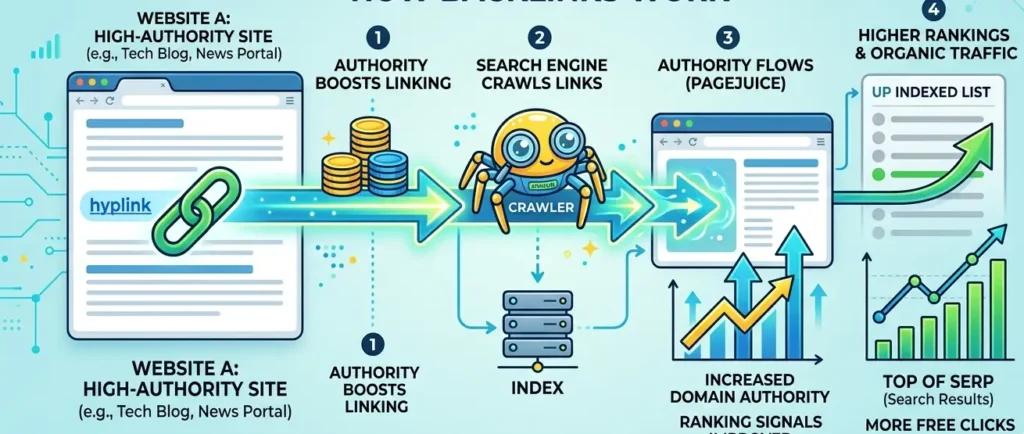
A backlink is essentially a vote of confidence from one website to another. When a reputable blog links to your article about SEO, they’re signaling to Google: “This content is worth reading.” The more credible the website linking to you the stronger that vote becomes.
Here’s a simple example. Imagine you run a small food blog. If a famous culinary magazine links to your recipe guide, Google interprets that as strong validation. That single link can do more for your rankings than dozens of links from low-quality directories.
How Search Engines Use Backlinks?
Google original breakthrough the PageRank algorithm was built on one core idea a page that receives many links from trusted sources must be important. While the algorithm has evolved enormously since then, backlinks remain a central ranking signal.
Google uses backlinks to:
- Discover new pages across the web
- Measure the credibility and authority of a website
- Understand which pages deserve to rank for competitive keywords
- Evaluate topical expertise and relevance
Link Building vs Link Earning
There’s an important distinction worth understanding early:
Link building is the proactive process of outreach, pitching, and creating content designed to attract backlinks.
Link earning is what happens when your content is so useful or original that other websites link to it naturally without you asking.
Both matter. The best SEO strategies combine intentional outreach with content that earns links organically over time.
Why Is Link Building Important for SEO in 2026?
Some people claim link building is dead. It isn’t. What’s dead is lazy link building the kind that relies on spam, shortcuts and paid networks.
Here’s why quality link building still matters more than ever.
It Improves Search Rankings
Multiple large-scale studies confirm that top-ranking pages have significantly more backlinks than lower-ranking ones. Pages with strong backlink profiles consistently outrank thinner pages on competitive keywords even when the content quality is similar.
It Builds Website Authority
Domain Authority (a metric developed by Moz) and Domain Rating (used by Ahrefs) both measure how strong a website’s backlink profile is. Higher authority means Google is more likely to trust every page you publish not just the ones that already have links.
It Increases Organic Traffic
Backlinks don’t just help rankings. When a high-traffic website links to you, their audience sees that link and some of them click it. This is called referral traffic real visitors who arrive because another site sent them to you.
It Helps Search Engines Discover Your Pages
New websites are often invisible to Google simply because nothing links to them. A single backlink from an indexed, active website can accelerate Google’s crawling and indexing of your new content by days or even weeks.
It Strengthens Brand Trust
When your website is mentioned and linked to across respected publications, readers begin to recognize your brand as an authority. That trust translates into higher click-through rates, longer time-on-site, and better conversion rates all of which feed back into your SEO performance.
How Backlinks Work
Not all backlinks are equal. Understanding how they work technically helps you make smarter decisions about which ones to pursue.
Dofollow vs Nofollow Links
This is one of the first things every beginner needs to understand.
Dofollow links pass what’s called “link equity” ranking power from the linking site to yours. When a credible website gives you a dofollow link, it actively helps your rankings.
Nofollow links include a special HTML attribute (rel="nofollow") that tells search engines not to pass ranking credit. Social media links, many forum links, and some blog comment links are nofollow.
However, nofollow links are still valuable. They drive referral traffic, improve brand visibility, and create a natural-looking link profile.
| Link Type | SEO Value | Example Sources |
|---|---|---|
| Dofollow | High passes ranking power | Guest posts, editorial mentions |
| Nofollow | Indirect traffic and brand signals | Wikipedia, Twitter, news sites |
| Sponsored | Flagged as paid no direct SEO value | Paid placements |
| UGC | User-generated limited value | Forum posts, comments |
Link Equity Explained
Link equity (sometimes called “link juice”) is the SEO value passed through a backlink. A link from a page with high authority passes more equity than a link from a new, unknown blog. Think of it like a recommendation: a reference from an industry expert means more than one from a stranger.
Referring Domains
The number of unique websites linking to you called referring domains is often more important than the raw number of backlinks. One hundred links from one hundred different domains is generally more valuable than one hundred links from a single domain.
Anchor Text
Anchor text is the clickable, visible text of a hyperlink. If a site links to you with the anchor text “link building guide,” Google reads that as context for what your page is about. Diverse, natural anchor text signals healthy link building. Over-optimized anchor text where every link says the exact same keyword raises red flags.
Relevance and Authority
Google weighs two things above almost everything else when evaluating a backlink: relevance (does the linking site relate to your niche?) and authority (is it a credible, trusted source?). A link from a top SEO blog to your SEO article is worth far more than a link from a cooking website to the same page.
Types of Backlinks Beginners Should Know
Understanding the different types of backlinks helps you prioritize where to focus your energy.
Editorial Links
These are the gold standard. An editorial link is one that a writer or journalist includes in their content because they genuinely found your page useful or informative. You can’t buy these you earn them by creating content worth referencing.
Guest Post Links
When you write an article for another website in your niche, you typically earn a contextual link back to your own site. Guest posting is one of the most common and effective beginner link building strategies.
Resource Page Links
Many websites maintain “resource” or “recommended tools” pages that list helpful external links for their readers. Getting your content listed on these pages can produce high-quality, relevant backlinks.
Business Citation Links
For local businesses, citations listings on Google Business Profile, Yelp, and industry directories are important local SEO signals. These combine your business name, address, and phone number (NAP) consistently across the web.
Brand Mention Links
Sometimes your brand gets mentioned online without a hyperlink attached. Converting these unlinked brand mentions into actual backlinks is one of the easiest link building wins available.
Directory Links
Reputable, niche-specific directories (not generic link farms) can still provide value, especially for local SEO. Choose directories that are actively maintained and relevant to your industry.
Social Profile Links
LinkedIn, YouTube, Twitter, and similar platforms allow you to add your website URL. While most are nofollow, they contribute to a natural link profile and can drive real referral traffic.
Link Building Strategies for Beginners
Here are the safest, most effective strategies you can start using right now all white hat, all Google-compliant.
1. Create High-Quality, Linkable Content
Every other strategy on this list works better when your content is genuinely worth linking to. Before you start outreach, ask yourself: “Would I link to this if I found it?”
Content formats that naturally attract backlinks include:
Ultimate Guides Comprehensive, well-structured guides that cover a topic better than anything else available. Pages like “The Complete Beginner’s Guide to SEO” get referenced by bloggers, teachers, and journalists for years.
Original Research — Surveys, data studies, and industry reports are link magnets. When you publish original data, other websites cite you as a source — often with dofollow editorial links.
Statistics Posts — Roundups of the most relevant statistics in your niche. Bloggers frequently link to these when they need a quick data reference.
Case Studies — Real-world results with specific numbers. “How We Grew Organic Traffic by 287% in 6 Months” earns links because it demonstrates proof, not just theory.
2. Guest Posting
Guest posting means writing an article for another website in your niche in exchange for a contextual backlink. When done correctly, it builds authority, expands your audience, and earns links from relevant, credible sources.
How to find guest posting opportunities:
Search Google using these operators:
your niche + "write for us"your niche + "guest post guidelines"your niche + "submit an article"
Target websites that have real organic traffic, publish regularly, and are clearly relevant to your topic. Avoid sites that exist only to sell guest post placements — these are often low-quality and can harm rather than help.
Outreach email template:
Subject: Guest Post Idea for [Website Name]
Hi [Name],
I’ve been reading [Website] for a while especially enjoyed your recent piece on [specific article].
I’m an SEO writer focused on [your niche] and would love to contribute a guest post. Here are two ideas I think would work well for your audience:
- [Topic Idea 1]
- [Topic Idea 2]
Happy to share a full outline before writing anything. Let me know if either interests you.
Best, [Your Name]
Keep it short, personal, and specific. Generic outreach gets ignored.
3. Resource Page Link Building
Resource pages are goldmines for beginners. They already list external links — your job is to show the site owner that your content belongs on that list.
How to find resource pages:
your niche + "helpful resources"your niche + "useful links"your niche + "recommended reading"
Once you find a relevant resource page, send a brief, polite email introducing your content and explaining why it would add value for their readers. Personalize every pitch.
4. Broken Link Building
Websites frequently link to external pages that have since been deleted or moved creating dead “404” links. Broken link building involves finding these dead links, creating or identifying a replacement resource on your site, and contacting the website owner to suggest the swap.
The process:
- Install the free Chrome extension “Check My Links” or use Ahrefs
- Visit resource pages and blog posts in your niche
- Identify any broken outbound links
- If you have (or can create) a relevant replacement, email the site owner
- Keep the outreach friendly: “I noticed your link to [broken page] is no longer working I’ve written a similar guide that might work as a replacement: [your URL]”
This approach works because you’re helping the site owner fix a real problem, not just asking for a favor.
5. HARO and Digital PR
Digital PR is about getting your name, brand, or expertise mentioned in credible publications and earning editorial backlinks in the process.
HARO alternatives active in 2026:
- Qwoted — Journalists post source requests; you reply with expert insights
- Featured.com — Answer questions for upcoming articles across multiple publications
- JournoRequests on X (Twitter) — Real-time journalist requests using the hashtag #JournoRequest
The key is to respond quickly, be genuinely helpful, and keep answers concise. Journalists receive hundreds of responses get to the point.
Even one placement in a respected industry publication can produce months of ranking authority.
6. Brand Mention Link Reclamation
Set up Google Alerts for your brand name, website URL, and your name as an author. Every time your brand is mentioned online, you’ll receive a notification.
When you find an unlinked mention someone referenced your brand without including a hyperlink reach out and ask if they’d mind adding the link. The conversion rate on these requests is high because the person already likes your brand enough to mention it.
7. Internal Linking
This one is free, entirely in your control, and often overlooked. When you link between your own pages strategically, you help Google understand the structure of your site, distribute link equity, and make it easier for readers to explore your content.
Every new article you publish should link to two or three relevant pages already on your site and older pages should be updated to link to new ones.
Step-by-Step Link Building Process for New Websites
If you’re starting from zero, here’s a realistic, phase-by-phase approach.
Step 1: Publish Link-Worthy Content Before any outreach, make sure you have at least 5–10 solid pieces of content on your site. Nobody links to an empty website. Focus on your best, most comprehensive articles first.
Step 2: Optimize On-Page SEO Ensure your pages are technically sound and properly optimized. A strong backlink pointing to a page with poor on-page SEO is wasted potential.
Step 3: Build Foundational Links Create profiles on legitimate platforms: Google Business Profile, LinkedIn, relevant industry directories, and social media channels. These provide your first backlinks and help Google build an initial picture of your brand.
Step 4: Start Outreach Begin with broken link building and resource page outreach these have the highest response rates for new websites because you’re providing genuine value. Save guest posting for when you have a small portfolio to reference.
Step 5: Track Results Use Google Search Console (free) to monitor your backlinks and track keyword ranking changes. Use Ahrefs Webmaster Tools (also free) to audit your full backlink profile monthly.
Step 6: Scale What’s Working After two to three months, identify which strategies produced the most results and double down on those. SEO is not a set-and-forget activity it rewards consistency.
Best Link Building Tools in 2026
You don’t need expensive software to start. Here’s what works at every budget level.
Free Tools
Google Search Console – Shows you which sites link to yours, which pages receive the most links, and whether Google has flagged any manual actions against your site. Start here.
Ahrefs Webmaster Tools – Free version of Ahrefs that gives you a full backlink audit, broken link detection, and referring domain analysis for your own website.
Google Alerts – Set up alerts for your brand name to find unlinked mentions and track when new content about your niche gets published.
Hunter.io (free tier) – Find email addresses associated with specific domains. Useful for outreach prospecting.
Google Search Operators – Using search strings like inurl:resources + "SEO" directly in Google is completely free and highly effective for finding link opportunities.
Paid Tools
| Tool | Best For | Starting Price |
|---|---|---|
| Ahrefs | Backlink research, competitor analysis, prospecting | ~$99/month |
| SEMrush | Full SEO suite, backlink audits, brand monitoring | ~$100/month |
| Moz Pro | Link building workflows, local SEO | ~$99/month |
| BuzzStream | Outreach management, email tracking | ~$24/month |
For most beginners, Google Search Console + Ahrefs Webmaster Tools covers everything you need in the first 6–12 months for free.
White Hat vs Black Hat Link Building
Understanding this distinction is non-negotiable. Getting it wrong can get your website removed from Google’s index entirely.
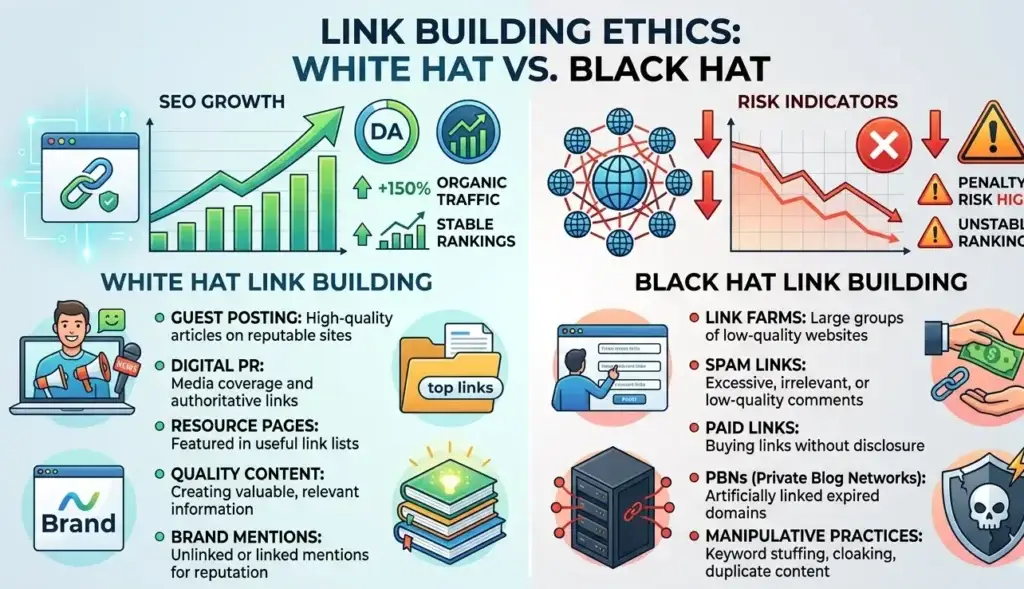
| Factor | White Hat | Black Hat |
|---|---|---|
| Approach | Earn links through value | Manipulate links artificially |
| Risk | Safe, long-term | Penalty risk, potential deindex |
| Timeline | Slower, sustainable | Fast short-term, unstable |
| Google’s stance | Encouraged | Against guidelines |
| Examples | Guest posts, HARO, content marketing | PBNs, paid links, link farms |
| Longevity | Links hold value for years | Often devalued or penalized |
White hat link building takes more time. But the results compound. A strong backlink profile built legitimately is an asset that keeps paying dividends for years.
Black hat shortcuts even when they work short-term carry the constant risk of a Google algorithm update wiping out everything you’ve built overnight.
Common Link Building Mistakes Beginners Must Avoid
These mistakes are responsible for more lost rankings than almost any other SEO error.
Buying Backlinks
Google’s SpamBrain algorithm specifically detects patterns associated with paid link schemes. A manual penalty which a real Google employee applies to your site can remove you from search results entirely. The risk is never worth it.
Using Private Blog Networks (PBNs)
PBNs are networks of fake websites built specifically to sell backlinks. Google is extremely effective at identifying and devaluing them. Any short-term ranking gains evaporate the moment Google catches up.
Submitting to Spam Directories
Not all directories are equal. Low-quality, generic “add your link here” directories provide no value and can actively harm your link profile. Stick to reputable, niche-specific directories.
Pursuing Irrelevant Links
A link from a gambling website to your SEO blog signals something’s wrong. Relevance matters enormously. Focus on links from websites that share your niche or audience.
Over-Optimizing Anchor Text
If 70% of your backlinks use the exact phrase “link building for beginners,” Google interprets that as manipulation. Natural link profiles have varied anchor text brand names, URLs, partial keywords, and generic phrases mixed together.
Prioritizing Quantity Over Quality
Ten editorial links from respected industry blogs will outperform a thousand links from low-quality sources every single time. Chase quality, not volume.
Ignoring Your Existing Backlink Profile
Competitors can point spammy links at your website in what’s known as a negative SEO attack. Monitor your backlink profile monthly using Ahrefs Webmaster Tools. If you find toxic links (from gambling, adult, or obvious spam domains), disavow them via Google Search Console.
How Long Does Link Building Take to Show Results?
This is the most common question beginners ask and the honest answer is: it depends.
Most SEO practitioners see initial ranking improvements within 3–6 months of consistent link building. However, several factors influence the timeline:
Domain Age – Newer domains take longer to build authority. Google applies what’s known as a “sandbox” effect on very new sites, limiting how fast rankings improve regardless of link velocity.
Competition Level – Ranking for “best coffee shop in Kuala Lumpur” is very different from ranking for “credit cards.” The more competitive the keyword, the more backlinks you need and the longer it takes.
Content Quality – A well-optimized, genuinely useful page gains more value from backlinks than a thin one. Always pair link building with strong on-page SEO.
Link Quality – One link from a high-authority, relevant site can produce visible ranking improvements within weeks. A hundred links from weak sources may produce no measurable change at all.
Set realistic expectations: consistent effort over 6–12 months produces compounding results. Trying to accelerate through shortcuts usually sets you back further than where you started.
Link Building Checklist for Beginners
Use this as a practical reference to keep your strategy on track.
Before You Start:
- Publish at least 5 high-quality, well-optimized articles
- Set up Google Search Console and verify your website
- Set up Ahrefs Webmaster Tools (free)Create Google Alerts for your brand name
- Create a Google Business Profile (if you’re a local business)
Weekly Actions:
- Check Google Alerts for new brand mentions
- Follow up on any unlinked mentions found
- Engage authentically in 2–3 niche communities (Reddit, LinkedIn, Quora)
- Share new content across social channels
Monthly Actions:
- Pitch 1–2 guest posts to relevant websites
- Run a backlink audit in Ahrefs Webmaster Tools
- Check for and disavow any obviously toxic links
- Identify 5 resource pages to pitch your content
Quarterly Actions:
- Publish one linkable asset (original data, ultimate guide, or free tool
- Analyze your top 3 competitors’ backlink profiles
- Review anchor text distribution for natural variety
- Assess topical authority growth through Search Console impressions
Conclusion
Link building is not a quick win. It never has been. But it remains one of the most reliable, high-impact investments you can make in your website’s long-term success.
Here are the key takeaways from this guide:
- Backlinks are votes of confidence from one website to another quality beats quantity every time
- White hat strategies (guest posting, resource pages, digital PR, broken link building) are safe, sustainable, and compound over time
- Black hat shortcuts carry real risks penalties that can set your site back by months or years
- New websites should start with foundational citations, then move to outreach and content-driven link earning
- Consistent effort over 6–12 months produces far better results than sporadic, high-volume activity
Your next step: Don’t try to implement everything at once. Start with one strategy creating one genuinely great piece of linkable content and build from there.
Every strong backlink profile started with a single link. Go earn yours.
This article was written based on current Google Webmaster Guidelines, industry best practices, and real-world SEO experience. All recommended strategies are white hat and Google-compliant as of 2026.
Author: Ali Rahbar | ClickBloomer.com | Digital Marketing & SEO Expert
What Is Technical SEO?
Technical SEO is the process of optimizing a website’s technical elements to help search engines crawl, index, and understand its content more effectively. It includes factors such as site speed, mobile-friendliness, XML sitemaps, structured data, and website security.
Why Is Technical SEO Important in 2026?
Technical SEO helps improve a website’s visibility in search engines by ensuring that pages are accessible, fast-loading, secure, and easy to crawl. It also enhances user experience, which can positively impact search rankings and organic traffic.
What Are the Most Important Technical SEO Ranking Factors?
Some of the most important technical SEO factors include Core Web Vitals, page speed, mobile responsiveness, HTTPS security, XML sitemaps, structured data, canonical tags, crawlability, and indexability.
How Often Should You Perform a Technical SEO Audit?
It is recommended to perform a technical SEO audit at least every 3–6 months. For large or frequently updated websites, monthly audits can help identify and resolve issues before they affect rankings and traffic.
Can a Website Rank Without Technical SEO?
A website may rank for some keywords without strong technical SEO, but technical issues can limit its ability to achieve and maintain higher rankings. Proper technical optimization ensures that search engines can efficiently crawl, index, and evaluate your content.