
Introduction
Let me be honest with you writing content that actually ranks on Google in 2026 is not the same as it was three or even two years ago. The game has shifted. Google’s Helpful Content System is smarter. AI search engines like Gemini, ChatGPT Search, and AI Overviews are changing how people find answers. And readers have become more demanding than ever.
The good news?
You don’t need to be a genius writer or an SEO expert with ten years of experience to create content that ranks. You just need a clear, repeatable process and that’s exactly what this guide gives you.
Whether you’re writing your first blog post or trying to fix why your existing content isn’t ranking, this step-by-step guide walks you through everything from keyword research and content structure to E.E.A.T optimization and AI search readiness.
By the end of this guide, you’ll know how to write content that Google loves, readers trust, and AI search engines recommend.
What You Learn: How to find the right keywords, structure your content for rankings, write for both humans and search engines, optimize for E.E.A.T and AI search, and measure your results.
What Is SEO Content Writing?
Definition of SEO Content Writing
SEO content writing is the process of creating written content that is designed to rank in search engine results pages (SERPs) while genuinely helping the reader. It combines the art of great writing with the science of search engine optimization.
Think of it this way: regular writing is like a brilliant book sitting in a library with no label. SEO content writing makes sure that book has the right title on the spine, sits on the right shelf, and shows up when someone searches for it.
SEO Writing vs Regular Writing
| Aspect | Regular Writing | SEO Content Writing |
|---|---|---|
| Goal | Entertain or inform | Rank + inform + convert |
| Keyword use | None or accidental | Strategic and intentional |
| Structure | Author’s preference | Optimized for search & readability |
| Audience | General readers | Specific searchers with intent |
| Measurement | Engagement / sales | Rankings, traffic, CTR, conversions |
Why SEO Content Matters in 2026
Organic search still drives more than 53% of all website traffic globally. Despite the rise of AI search, people are still clicking links they’re just making decisions faster. Here’s why SEO content writing is more critical than ever:
- Organic traffic is free, scalable, and compounds over time
- Well-written SEO content builds brand authority and reader trust
- It feeds AI Overviews Google’s AI pulls answers from well-structured content
- Strong content attracts natural backlinks, which boost rankings further
- It generates leads and conversions 24/7 without paid ad spend
How Search Engines Understand Your Content
Before you write a single word, understand how Google processes your content:
- Crawling: Googlebot visits your page and reads its HTML
- Indexing: Google analyzes and stores your content in its database
- Ranking: Google matches your content to search queries based on relevance, authority, and user experience
- Search Intent Analysis: Google checks if your content actually satisfies what the user was looking for
Pro Tip: Google doesn’t just read your words it understands topics, entities, and context. Writing for ‘semantic search’ means covering a topic fully, not just repeating a keyword.
How SEO Content Writing Has Changed in 2026
Google Focus on Helpful Content
Since 2022, Google has been rolling out its Helpful Content System a series of updates that reward content written for people first, not for search engines. In 2026, this system has matured and become a core part of how Google evaluates every piece of content.
What does ‘helpful content’ actually mean? Google’s own documentation describes it as content that leaves users feeling satisfied like they got exactly what they came for without having to visit five more websites.
- Write from genuine knowledge and experience, not just research
- Answer the actual question the user typed don’t dance around it
- Avoid content that exists purely to rank without adding real value
- Don’t publish thin content that covers a topic superficially
AI Search and Generative Engines
AI search is no longer a future trend it’s the present reality. Here’s how the major AI search systems work in 2026:
| AI Search Platform | What It Does | How to Optimize For It |
|---|---|---|
| Google AI Overviews | Shows AI-generated answers above organic results | Write clear definitions, direct answers, and use structured headings |
| ChatGPT Search | Pulls web results into conversational responses | Use authoritative language, clear facts, and cite sources |
| Gemini AI | Google’s AI assistant integrated into search | Focus on topical depth and entity-based content |
| Perplexity AI | Citation-heavy AI search engine | Ensure factual accuracy and include structured data |
Why Keyword Stuffing Kills Rankings in 2026
Keyword stuffing repeating your target keyword unnaturally was already declining in effectiveness years ago. In 2026, it actively harms your rankings. Google’s language models can detect unnatural keyword patterns and penalize them.
Modern ranking signals focus on:
- Semantic relevance – covering related topics and subtopics
- Natural language – writing the way real people speak and think
- User satisfaction signals – time on page, scroll depth, click-through rate
- Topical authority – being a trusted source on a subject area
Understanding Search Intent Before You Write
What Is Search Intent?
Search intent (also called user intent) is the reason behind a search query. When someone types something into Google, they have a goal and Google’s entire job is to match content that satisfies that goal. If your content doesn’t match the intent, it won’t rank even if it’s perfectly written.
The Four Main Types of Search Intent
| Intent Type | What the User Wants | Content Format That Works | Example Query |
|---|---|---|---|
| Informational | To learn something | Blog posts, guides, tutorials | How does SEO content writing work? |
| Navigational | To find a specific website | Brand/product pages | ClickBloomer blog |
| Commercial | To compare options before buying | Reviews, comparisons, listicles | Best SEO content writing tools 2026 |
| Transactional | To buy or take action | Product/service/landing pages | Hire SEO content writer |
How to Identify the Right Intent for Your Article
The easiest way to identify search intent is to Google your target keyword and analyze the top 5–10 results. What type of content is ranking?
- Mostly blog posts or guides → informational intent
- Mostly product pages or pricing pages → transactional intent
- Mostly comparison articles → commercial intent
- Mostly a specific website → navigational intent
Quick Rule: Match your content format to what’s already ranking. If Google shows blog posts for your keyword, write a blog post not a product page.
Find the Right Keywords
What Are SEO Keywords?
Keywords are the words and phrases people type into search engines. Finding the right keywords is the foundation of SEO content writing get this wrong, and even perfect content won’t find the right audience.
Types of Keywords You Need to Know
- Short-tail keywords: Broad, high-volume terms (e.g., ‘SEO writing’). Hard to rank for, less specific.
- Long-tail keywords: Specific, lower-volume phrases (e.g., ‘SEO content writing for beginners 2026’). Easier to rank, more targeted.
- Question keywords: Phrased as questions (e.g., ‘How do I write SEO-friendly content?’). Great for featured snippets.
- LSI keywords: Related terms that support your main keyword (e.g., ‘search engine optimization’, ‘content strategy’, ‘meta description’).
- Semantic keywords: Conceptually related terms Google associates with your topic.
Best Keyword Research Tools in 2026
| Tool | Best For | Free or Paid? | Beginner Friendly? |
|---|---|---|---|
| Google Keyword Planner | Search volume & competition data | Free (needs Google Ads account) | Yes |
| Ubersuggest | Long-tail ideas, beginner research | Free (limited) / Paid | Very Yes |
| Ahrefs | Deep competitor analysis, backlink data | Paid | Moderate |
| Semrush | Comprehensive SEO research | Paid (free trial) | Moderate |
| Keyword Surfer (Chrome Extension) | Quick search volume while browsing | Free | Yes |
| Google Search Suggestions | Real user queries, People Also Ask | Free | Yes |
How Beginners Can Find Low-Competition Keywords
As a beginner, competing for short-tail keywords like ‘SEO writing’ is nearly impossible established sites with thousands of backlinks dominate those. The smart approach is to find long-tail, low-competition keywords.
- Go to Google and type your topic. Note the autocomplete suggestions.
- Scroll to the bottom of the SERP and check ‘Searches related to…’
- Click on a few results and check their ‘People Also Ask’ box
- Use Ubersuggest to check keyword difficulty score (aim for under 30 as a beginner)
- Look for question-based keywords they often have lower competition
Keyword Research Example (Step-by-Step)
Let’s say you want to write about SEO content writing. Here’s the process:
- Start broad: ‘SEO content writing’
- Get specific: ‘SEO content writing for beginners’
- Add a year: ‘SEO content writing for beginners 2026’
- Check related terms: ‘how to write SEO articles’, ‘SEO blog writing tips’, ‘content writing for Google ranking’
- Choose your primary keyword and gather 5–8 secondary/LSI keywords
**Real Example: **The primary keyword for this very article is ‘SEO content writing for beginners 2026’. Secondary keywords include: SEO article writing, how to write SEO content, content writing tips for beginners, write for Google 2026.
Analyze the Top Ranking Competitors
Why Competitor Analysis Matters
Before writing a single word, spend 20–30 minutes analyzing what’s already ranking on page 1 for your keyword. This tells you what Google considers the ideal content for that query and gives you a blueprint to beat it.
What to Analyze in Competitor Articles
- Word count: How long are the top articles? Match or exceed the average.
- Headings structure: What H2s and H3s are they using? What subtopics do they cover?
- Content format: Are they using lists, tables, step-by-step guides, or long paragraphs?
- Featured snippets: Is any competitor owning a snippet? What format does it use?
- FAQs: What questions do they answer? Check their FAQ section.
- Internal links: What pages do they link to? Note topic clusters.
- Gaps: What do all competitors miss? That’s your opportunity.
Competitor Research Checklist
- Open top 5 Google results for your keyword
- Note the average word count
- List all H2 headings across articles
- Identify topics covered by 3+ competitors (must include these)
- Find topics no one covers well (your differentiator)
- Check what type of featured snippet appears (if any)
- Review the FAQ/People Also Ask section
Create a Winning Content Outline
Why Outlines Improve Your Rankings
Skipping the outline is one of the biggest mistakes beginners make. A good outline does three things: it keeps your writing focused, ensures you cover all subtopics Google expects, and helps you organize internal links logically before you write.
Think of your outline as the architectural blueprint before building a house. You wouldn’t start laying bricks without knowing where the walls go.
Building Topic Clusters
In 2026, Google rewards websites that demonstrate topical authority meaning you cover a subject in depth across multiple related articles, not just one. A topic cluster consists of:
- Pillar page: A comprehensive guide on a broad topic (e.g., ‘Complete SEO Guide’)
- Cluster pages: Detailed articles on subtopics (e.g., ‘Keyword Research’, ‘On-Page SEO’, ‘SEO Content Writing’)
- Internal links: Each cluster page links back to the pillar, and the pillar links to all clusters
How to Organize Headings Properly
| Heading Level | Purpose | Example |
|---|---|---|
| H1 | Main article title one per page only | SEO Content Writing for Beginners 2026 |
| H2 | Major sections of the article | Step 1 – Find the Right Keywords |
| H3 | Subsections within an H2 | Types of Keywords You Need to Know |
| H4 | Specific items within an H3 (use sparingly) | Short-Tail Keywords Explained |
Write High-Quality SEO Content
How to Write an Engaging Introduction
Your introduction has one job: make the reader want to keep reading. You have about 10–15 seconds before someone decides to leave or stay. Here’s a formula that works:
- Hook: Start with a surprising fact, bold statement, or relatable problem
- Problem: Acknowledge the pain point the reader is experiencing
- Promise: Tell them exactly what they’ll get from this article
- Credibility: Briefly signal why you’re worth listening to
**Example Hook: **’Let me be honest writing content that ranks in 2026 is harder than ever. But it’s also more achievable than ever if you follow the right process.’
Writing Clear and Helpful Content
Every sentence should earn its place. Ask yourself: ‘Does this sentence help the reader or just fill space?’ If it’s filler, cut it. Here’s what makes content genuinely helpful:
- It answers the question completely, not partially
- It uses plain language no unnecessary jargon
- It gives specific examples, not vague generalities
- It acknowledges limitations and doesn’t oversell
- It anticipates follow-up questions and answers them proactively
How to Use Keywords Naturally
Use your primary keyword in the title, first 100 words, at least one H2, and naturally throughout the article. Aim for a keyword density of 1–2% that’s roughly 1–2 mentions per 100 words. Never force it.
For secondary and LSI keywords, sprinkle them naturally where they fit. If a sentence sounds awkward, rewrite it until it flows. A reader should never feel like they’re reading a keyword-stuffed article.
Improving Readability
- Short paragraphs: 2–4 lines maximum. White space is your friend.
- Simple language: Write at a Grade 8–10 reading level. Use Hemingway Editor to check.
- Active voice: ‘Google rewards helpful content’ beats ‘Helpful content is rewarded by Google.’
- Transition words: Use words like ‘However As a result For example In other words’ to guide the reader.
- Varied sentence length: Mix short punchy sentences with longer explanatory ones.
Content Formatting Best Practices
Formatting is not just cosmetic it directly affects how long people stay on your page, which affects your rankings. Use these formatting techniques:
- Use H2 and H3 headings to break up long sections
- Use bullet points or numbered lists for multi-item information
- Use tables when comparing options or showing structured data
- Bold key terms and important phrases but sparingly (not every sentence)
- Use callout boxes or highlighted text for important tips or warnings
Optimize Content for E.E.A.T
What Is E.E.A.T?
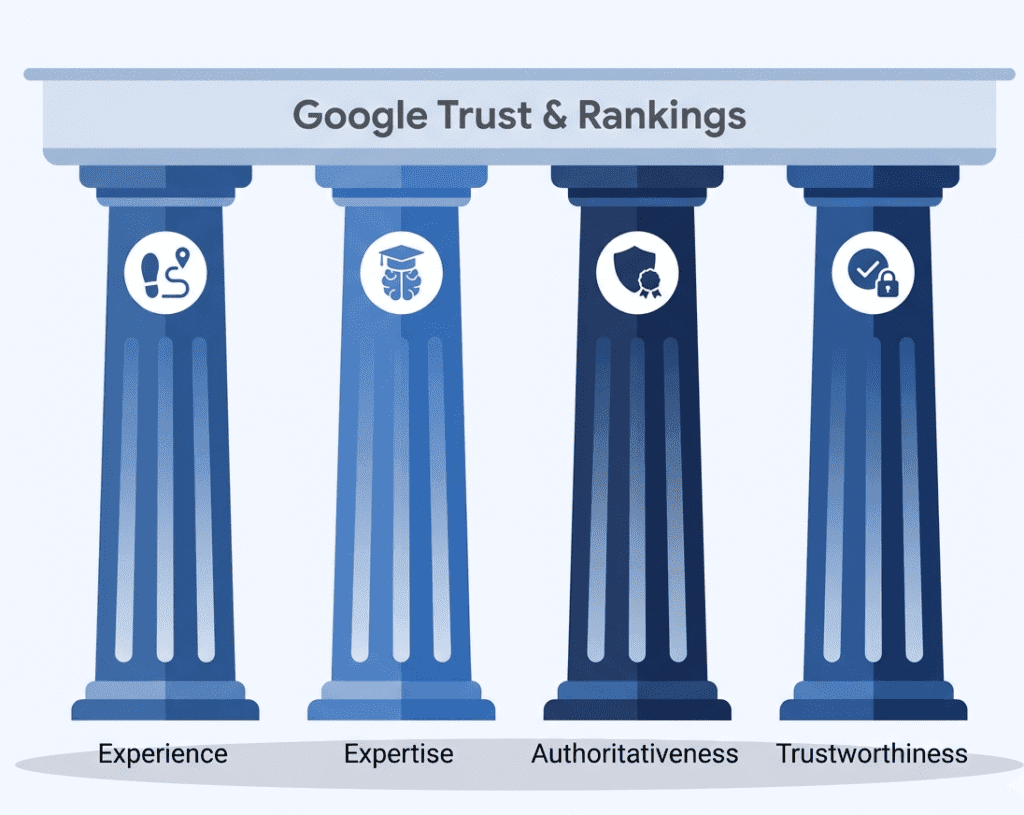
E.E.A.T stands for Experience, Expertise, Authoritativeness, and Trustworthiness. It’s Google’s framework for evaluating whether a piece of content deserves to rank highly. It’s not a direct ranking factor it’s how Google’s Quality Raters assess the overall quality of your site and content.
| EEAT Signal | What It Means | How to Show It |
|---|---|---|
| Experience | First-hand knowledge of the topic | Share personal examples, case studies, real outcomes |
| Expertise | Deep subject-matter knowledge | Accurate information, proper terminology, nuanced insights |
| Authoritativeness | Recognition as a trusted source | Backlinks, author bio, mentions from credible sources |
| Trustworthiness | Honest and reliable information | Cite sources, correct information, no misleading claims |
Practical Ways to Improve Your E.E.A.T
- Write a detailed author bio with credentials and experience
- Include real-world examples from your own experience
- Add a ‘Last updated’ date to articles to show freshness
- Link to authoritative external sources (Google, Ahrefs, reputable studies)
- Include a clear editorial policy or about page on your site
- Use real data and statistics with source citations
- Add a professional headshot and author profile page
Common EEAT Mistakes Beginners Make
- Publishing content with no author information
- Making vague claims without evidence (‘many experts say…’)
- Using outdated information or statistics without noting the date
- Copying competitor content structure without adding original insights
- Skipping the experience layer writing like a textbook, not a practitioner
On-Page SEO Optimization
Writing SEO-Friendly Titles
Your title tag is the first thing both users and Google see. It needs to include your primary keyword, ideally near the beginning, and be compelling enough to get clicked.
- Keep titles under 60 characters to avoid truncation in SERPs
- Include the primary keyword naturally in the title
- Use power words: ‘Complete’, ‘Step-by-Step’, ‘Ultimate’, ‘Beginner’s Guide’, ‘2026’
- Test your title emotionally does it make someone want to click?
Optimizing Meta Descriptions
Meta descriptions don’t directly affect rankings, but they massively affect click-through rates (CTR). A good meta description acts as a mini-ad for your article.
- Keep it between 140–160 characters
- Include your primary keyword naturally
- Include a clear benefit or call to action
- Make it match the content misleading descriptions increase bounce rates
*Example Meta Description: *‘Learn SEO content writing for beginners in 2026 with this complete step-by-step guide. Covering keyword research, EEAT, AI search optimization, and more.‘
URL Structure Best Practices
- Keep URLs short, descriptive, and lowercase
- Use hyphens (-) to separate words, never underscores
- Include your primary keyword in the URL
- Avoid dates in URLs unless the content is truly time-sensitive news
- Example: /seo-content-writing-for-beginners-2026/
Image Optimization
- Use descriptive file names: ‘seo-content-writing-checklist.png’ not ‘image001.png’
- Always add alt text that describes the image and includes the keyword naturally
- Compress images before uploading use WebP format for smaller file sizes
- Add captions where appropriate they improve accessibility and engagement
Internal Linking Strategy
Internal links do two important things: they help Google understand your site structure, and they keep readers on your site longer by guiding them to related content.
- Link to 3–5 related articles within every new article you publish
- Use descriptive anchor text not ‘click here’ but ‘keyword research guide’
- Link to your most important pages from high-traffic articles
- Create a logical topic cluster structure with internal links
Schema Markup Basics
Schema markup is structured data code that helps search engines understand your content and display rich results. For beginners, the most useful types are:
- Article schema: Tells Google your content is an article with an author and publish date
- FAQ schema: Enables your FAQ questions to appear as expandable rich results in SERPs
- HowTo schema: Helps step-by-step guides appear with structured steps in search results
Optimize Content for AI Search Engines
What Is AI SEO?
AI SEO is the practice of optimizing your content to be featured in AI-generated search answers including Google’s AI Overviews, ChatGPT Search responses, Gemini summaries, and Perplexity citations. In 2026, being included in AI answers can drive significant traffic even without a traditional top-10 ranking.
How AI Search Engines Choose Sources
AI search engines scan the web for content that is:
- Clearly structured with headings and logical flow
- Factually accurate and aligned with consensus knowledge
- Written by recognized entities or authoritative domains
- Formatted with direct answers near the top of sections
- Rich in specific data, statistics, and concrete examples
Creating AI-Friendly Content
- Use a clear ‘What Is X?’ definition early in your article
- Include a concise summary box at the top or bottom
- Answer questions directly in the first 1–2 sentences of each section
- Use numbered lists for processes AI systems extract these easily
- Include a robust FAQ section with direct, concise answers
Entity-Based SEO
Modern search engines understand entities real-world things like people, places, organizations, and concepts. By clearly naming and defining entities in your content, you help AI and search engines understand exactly what your article is about.
- Name specific tools, companies, people, and concepts
- Use official names and include brief definitions
- Link entities to authoritative sources where appropriate
- Build topical depth by covering all major entities related to your topic
Topical Authority Building
The most powerful long-term SEO strategy in 2026 is topical authority becoming the most comprehensive resource on a subject. To build it:
- Create a pillar article on your main topic
- Write detailed cluster articles for every major subtopic
- Internally link all cluster articles to the pillar
- Update older articles regularly to keep them fresh
- Answer every question a beginner, intermediate, and advanced reader might have
Publish and Promote Your Content
Publishing Checklist
- Final proofread (grammar, spelling, factual accuracy)
- Primary keyword in title, first paragraph, and at least one H2
- Meta description written and optimized
- URL slug set correctly
- All images have alt text
- 3–5 internal links added
- 1–3 external links to authoritative sources
- Schema markup added (if applicable)
- Categories and tags properly set
- Social sharing image (OG image) uploaded
Content Distribution Channels
Publishing is only half the job. Content promotion is what accelerates your initial traffic before Google fully indexes and ranks your article.
- Social media: Share on LinkedIn, X (Twitter), Facebook, Instagram Stories
- Email marketing: Send to your subscriber list with a compelling subject line
- Online communities: Share in relevant Reddit threads, Facebook Groups, Quora answers
- Content repurposing: Turn the article into a YouTube video, infographic, or social carousel
- Outreach: Email 3–5 people mentioned in your article to let them know
Building Backlinks Naturally
Backlinks from other websites are still one of Google’s strongest ranking signals. You can’t buy good backlinks but you can earn them by:
- Creating content so good that people reference it naturally
- Guest posting on relevant industry blogs
- Being featured in podcasts or interviews
- Creating original research or data that others cite
- Submitting to resource pages in your niche
Measure SEO Performance
Important SEO Metrics to Track
| Metric | What It Measures | Target Benchmark |
|---|---|---|
| Organic traffic | Visitors from search engines | Consistent monthly growth |
| Keyword rankings | Your position for target keywords | Page 1 (top 10) for primary keyword |
| Click-through rate (CTR) | % of searchers who click your result | 3–5%+ for informational content |
| Average position | Mean ranking across all keywords | Improve over 90 days |
| Time on page | How long readers stay | 2+ minutes for long-form content |
| Bounce rate | % who leave without clicking further | Below 70% for blog content |
Google Search Console Basics
Google Search Console (GSC) is the most important free SEO tool you have and it’s often overlooked by beginners. Here’s how to use it for content improvement:
- Performance report: See which keywords you’re ranking for and your average CTR
- Coverage report: Find pages with indexing errors that need fixing
- URL Inspection: Check if a specific page is indexed correctly
- Core Web Vitals: See how fast your pages load and fix performance issues
Content Improvement Based on Data
After 3–6 months, revisit your published articles and update them using this process:
- Check GSC for keywords ranking on positions 8–20 these have easy rank improvement potential
- Add missing subtopics that competitors cover but you don’t
- Update outdated statistics, tools, or recommendations
- Improve the introduction or title if CTR is below average
- Add more internal links to and from this article
Common SEO Content Writing Mistakes to Avoid
| Mistake | Why It Hurts You | The Fix |
|---|---|---|
| Keyword stuffing | Triggers Google spam filters, bad UX | Write naturally; target 1–2% keyword density |
| Thin content | Doesn’t rank; readers leave immediately | Write 1,500+ words for competitive keywords |
| Ignoring search intent | Content won’t rank even if optimized | Always analyze SERP before writing |
| Poor internal linking | Misses ranking signals and reader engagement | Add 3–5 relevant internal links to every article |
| No EEAT signals | Google won’t trust or rank the content | Add author bio, real examples, and cite sources |
| Publishing without optimization | Misses easy ranking boosts | Use a pre-publish checklist every time |
| Writing only for search engines | Readers leave → bad engagement signals | Write for humans first, optimize second |
SEO Content Writing Checklist for Beginners
Before Writing
- Target keyword researched and confirmed
- Search intent identified
- Top 5 competitors analyzed
- Content outline created with H2s and H3s
- Secondary and LSI keywords gathered
During Writing
- Primary keyword in first 100 words
- Natural keyword use throughout (1–2% density)
- Short paragraphs (2–4 lines)
- Headings properly hierarchized (H1 > H2 > H3)
- Real examples and personal insights included
- EEAT signals demonstrated throughout
Before Publishing
- Title tag optimized (under 60 characters)
- Meta description written (140–160 characters)
- URL slug set correctly
- All images have descriptive alt text
- 3–5 internal links added
- External links to authoritative sources added
- FAQ section with schema-friendly answers
- Content proofread for grammar and factual accuracy
After Publishing
- Article submitted to Google Search Console for indexing
- Shared on social media and email list
- Shared in relevant online communities
- Calendar reminder set to update in 6 months
- Monitoring set up in GSC and Google Analytics 4
Best AI Tools for SEO Content Writing in 2026
How to Use AI Tools Correctly
Let’s be clear about one thing: AI tools are assistants, not replacements. Google’s spam policies target AI-generated content that provides no original value. The best approach in 2026 is to use AI to speed up your process while ensuring every final article has your genuine insights, examples, and voice.
| AI Tool | Best Use Case | What NOT to Use It For |
|---|---|---|
| ChatGPT (GPT-4o) | Brainstorming, outlines, first drafts | Final publication without human editing |
| Claude (Anthropic) | Long-form drafts, research summaries | Replacing your own expertise and examples |
| Gemini | Google-integrated research and summaries | Auto-publishing without review |
| Surfer SEO | Content scoring and keyword density optimization | Over-optimizing to the point of unnatural writing |
| Frase | Content briefs and SERP analysis | Replacing deep competitor research |
| Clearscope | Semantic keyword optimization | Forcing in every suggested keyword |
The Right Way to Use AI for SEO Content
- Use AI to generate a content outline based on your keyword
- Review and customize the outline with your own expertise
- Use AI to draft individual sections you can then edit and improve
- Add your real-world examples, case studies, and original insights
- Use AI to generate FAQ answers then verify every fact
- Run the draft through Hemingway Editor for readability
- Never publish AI content without a thorough human review
Real Example of SEO Content Writing (Case Study)
The Scenario
A beginner blogger wants to rank for ‘how to do keyword research for free. Let’s walk through the complete process.
Step 1: Keyword Selection
- Primary keyword: ‘how to do keyword research for free’
- Keyword difficulty: 22/100 (low competition 6 ideal for beginners)
- Monthly search volume: 1,200 manageable, targeted audience
- Search intent: Informational user wants a how-to guide
Step 2: Competitor Analysis Findings
- Top 5 results averaged 2,400 words
- All used H2 headings for each tool or step
- Most included a comparison table of free tools
- None had a beginner-focused FAQ section opportunity identified
Step 3: Content Outline Built
- Introduction with pain point: ‘Paid tools are expensive but you don’t need them’
- What is keyword research? (definition for AI overview)
- Step-by-step process using only free tools
- Comparison table of 5 free keyword research tools
- Common mistakes to avoid
- FAQ section targeting ‘People Also Ask’ questions
Step 4: Optimization Applied
- Primary keyword in title, meta, first paragraph, one H2
- Secondary keywords naturally used: ‘free keyword tools’, ‘Google Keyword Planner tutorial’
- 3 internal links added to related articles on the blog
- FAQ schema markup added to FAQ section
Results After 90 Days
- Page ranked #4 on Google for the primary keyword
- Featured in a Google AI Overview for a related question
- Generated 420+ organic visitors per month
- 2 natural backlinks earned from other bloggers referencing the article
Lesson: Low-competition long-tail keywords + thorough content + proper E.E.A.T + consistent publishing = results even for brand new bloggers.
Future of SEO Content Writing Beyond 2026
AI Search Will Keep Growing
AI Overviews and generative search are still evolving. By 2027–2028, a significant percentage of searches may be answered entirely by AI without a traditional click. The solution? Become a cited source. Create content so authoritative and well-structured that AI systems pull from you.
Personal Experience Will Matter More
Google is actively prioritizing content written by people with real experience. The rise of ‘been there, done that’ content over ‘here’s what the internet says’ content is only going to accelerate. Your personal case studies, examples, and opinions are your competitive edge over AI-generated content.
Topical Authority Over Individual Articles
Building a complete topic cluster will matter more than any single article. Search engines are getting better at assessing site-wide authority on subjects. A site that covers ‘SEO content writing’ deeply across 20 articles will outperform a site with one brilliant article.
Content Quality Trends
- Original research and proprietary data will be premium ranking signals
- Video content embedded in articles will boost engagement signals
- Multimedia content (audio, interactive tools) will differentiate top-ranking content
- Content freshness will matter more regular updates will be rewarded
Conclusion
SEO content writing is not a trick or a hack it’s a craft. And like any craft, it gets better with practice, feedback, and a commitment to genuinely helping your readers.
Here’s your step-by-step recap:
- Start with thorough keyword research find what people are actually searching for
- Analyze your competitors before writing understand what Google already rewards
- Create a solid outline structure your content logically before you write
- Write for humans first clear, helpful, engaging content that answers the real question
- Optimize for E.E.A.T demonstrate experience, expertise, authority, and trust
- Apply on-page SEO title, meta, URL, headings, images, and internal links
- Optimize for AI search clear definitions, direct answers, FAQs, entity coverage
- Publish and promote don’t just wait for Google; distribute your content
- Measure and improve use GSC and GA4 to refine your strategy over time
The beginner who writes one high-quality, fully optimized article per week consistently will almost always outperform the advanced writer who publishes sporadically and inconsistently. Consistency is your secret weapon.
Now go write something helpful.